From Bandstand to Seaside Pavilion
From bandstand to seaside pavilion, learn how coastal performance spaces became familiar live-music settings and what their design asks of a concert.
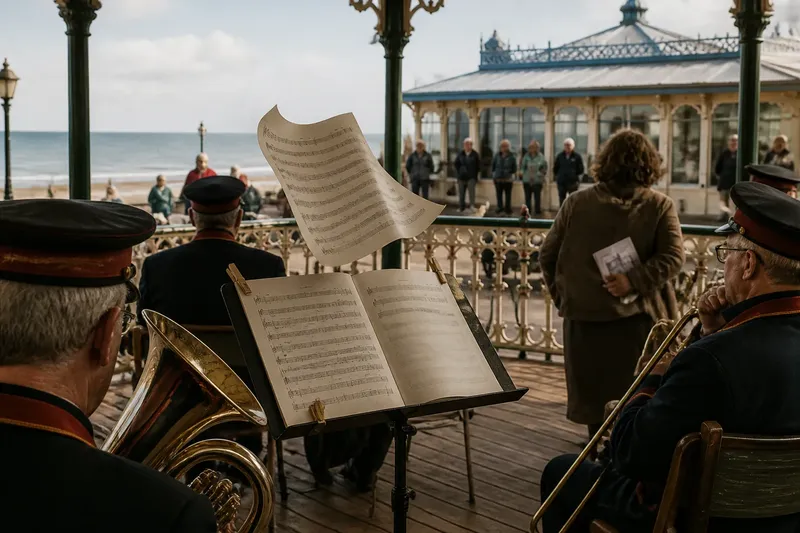
A brass band pauses as a gust lifts sheet music from the stand; a few rows back, someone pins a programme beneath a coat. The bandstand and seaside pavilion grew into familiar settings for live music because they gave public performance a place beside the promenade, where a passing crowd could become an audience.
These spaces were not simply smaller versions of concert halls. Their stages, access and relationship with the shoreline shaped how musicians played and how listeners gathered. Tracing that change means looking at what each kind of venue was built to do, and what happens when its original purpose meets a modern concert.
Why did promenades acquire bandstands?
A bandstand offered a defined place for music without closing off the surrounding public space. Its raised platform made performers visible across a garden, common or seafront, while open sides allowed people to listen from different directions. Visitors did not necessarily need to arrive for a formal performance; they could stop during a walk or stay for a set.
That arrangement suited music that could carry a clear tune to a loosely gathered crowd. Brass and military bands, for example, could play pieces listeners recognised without relying on a quiet room or close attention to every word. The setting encouraged a social kind of listening: a group might stand near the platform, while others heard a few numbers from a bench or the promenade.
Bandstands also gave a seaside resort a recognisable civic feature. Their decorative roofs and railings made them landmarks as well as performance platforms. A bandstand could anchor a public garden, signal a place to pause, and make music part of the ordinary route along the shore.
What changed when pavilions arrived?
A pavilion provided a more substantial setting for audiences and performers. Rather than an exposed platform alone, it could bring a roof, walls, seating, a larger stage and spaces for gathering under one structure. The building made it easier to host events that needed a longer programme, a larger audience or a more defined entrance and exit.
That shift changed the character of a visit. A bandstand often belonged to an open public landscape; a pavilion could make the concert itself the destination. Its enclosed or partly enclosed areas also offered shelter when the weather turned, although a covered venue still had to contend with wind, damp air and the sound of the sea beyond its walls.
The word “pavilion” covers many designs, so the name alone does not tell a visitor whether a performance will be seated, open-sided or fully indoors. Check the venue’s current access and event information, as arrangements vary by building and occasion.
How did the buildings shape the audience?
At a bandstand, listeners could gather informally and move around the performance. That made the music visible as a public activity rather than a private appointment. The audience might include people who had come specifically to hear the band and people who encountered it while out by the water.
A pavilion could organise that crowd more deliberately. Entrances, rows of seats and a defined stage helped direct attention towards performers, while a roof made it possible to treat the event as a complete evening out. The result was not a simple replacement of one audience by another: many coastal places kept both kinds of space, serving different moods and scales of performance.
For musicians, the difference mattered too. A bandstand’s open plan placed performers in direct contact with the surrounding landscape and crowd. A pavilion’s stage could provide clearer boundaries between players and listeners, along with room for larger ensembles or equipment, depending on its layout.
What trouble can arise when these spaces host a concert?
Why can a bandstand feel too exposed?
An open platform leaves performers and music directly affected by the elements. Wind can disturb loose papers or make an uncovered performance uncomfortable, while listeners may drift in and out rather than settle. For a small acoustic group, consider a concise set, secure music with clips and choose material that can be followed even when the audience is moving.
Why might a pavilion feel less connected to the seafront?
Walls, doors and fixed seating can make a pavilion feel like a separate destination rather than part of a promenade. A host can help bridge that gap by making the entrance easy to find and giving clear directions from the nearest public path. If the event suits it, a brief pause outside can let people reorient themselves before or after the performance.
Why can a historic setting complicate modern staging?
An older platform or pavilion may have limited room for contemporary equipment, performers or audience access. Before planning a show, compare the event’s needs with the venue’s published layout and speak with its operator about what the space can accommodate. Avoid assuming that a stage which looks spacious from the audience will have the same usable area behind it.
Why can the audience be unsure where to gather?
A public bandstand may have several approaches and no obvious queue, while a pavilion can have entrances that are less visible from the promenade. A simple sign at the nearest path, paired with consistent event information, helps visitors tell where to listen and whether they should enter or remain in the open area. Keep any route clear for people who are passing through.
How should a concert use the setting?
Start by deciding whether the event should feel like a public encounter or a destination performance. A short outdoor set can suit the bandstand’s open, passing audience; a longer programme may make better use of a pavilion’s stage and audience areas. The choice should follow the building and the intended listening experience, not just the venue’s name.
Say a community group has been invited to play at a small bandstand beside a promenade. It could choose a handful of familiar, self-contained pieces, secure its music and place a clear notice at the path; the expected result is that passers-by can understand what is happening and join for as long as they wish. The same set might need a different introduction and pacing in a pavilion, where listeners are more likely to have arrived for the whole performance.
For organisers, the practical first checks are the platform’s usable space, the audience’s route, shelter options and the venue’s rules for equipment and access. For listeners, the useful question is whether the event is designed for a casual stop or a settled seat. Those details reveal how the old distinction between bandstand and pavilion still shapes a night of coastal live music.
From bandstand to seaside pavilion, the lasting tradition is not one fixed style of concert but the way music belongs to a place people already use. Look at where the performers stand, how the crowd arrives and whether the shore remains in view; those features tell you what kind of listening the venue invites.